The Lipid Profile (also known as a Complete Lipid Panel) is one of the most critical cardiovascular diagnostic screenings in modern medicine. Cholesterol is a waxy, fat-like substance synthesized primarily by the liver that is essential for building cellular membranes, producing steroid hormones (estrogen, testosterone, cortisol), and synthesizing bile acids for fat digestion. However, because lipids are insoluble in water, they must be packaged into spherical protein carriers called lipoproteins to circulate through the bloodstream. When atherogenic lipoproteins circulate in excess, they penetrate the arterial intima, initiating plaque formation and drastically elevating the risk of coronary artery disease, angina, and ischemic stroke.
What Is a Lipid Profile Test?
A standard lipid profile measures both the quantitative concentrations of circulating cholesterol particles and storage fats (triglycerides) in your blood. In South Asian populations—who have a 3- to 4-fold higher genetic vulnerability to premature coronary artery disease compared to Western cohorts—annual lipid screening is essential starting in young adulthood. You can book an accurate Lipid & Heart Checkup at home with Mission100.
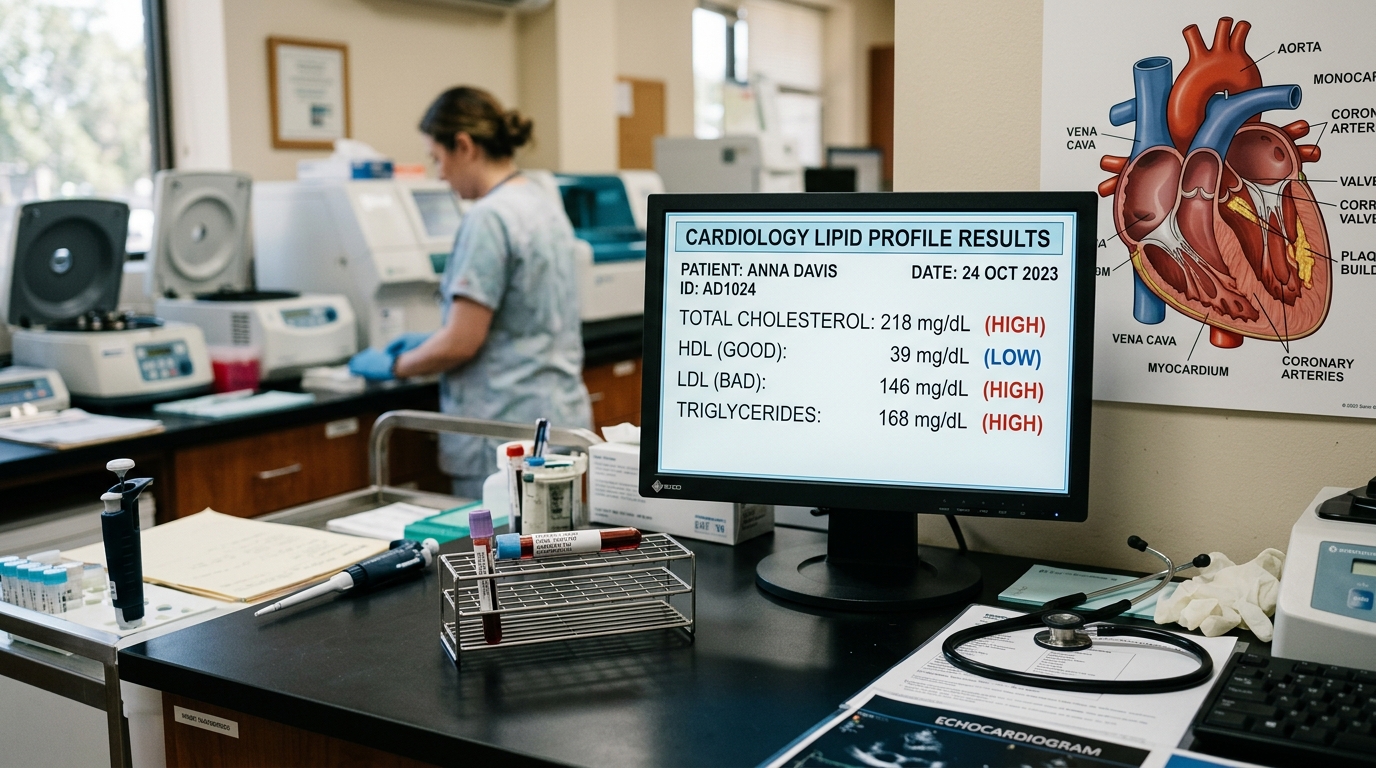
Breaking Down the Lipid Fractions
A comprehensive lipid report breaks down your blood lipids into several distinct fractions:
1. Total Cholesterol
The sum of all cholesterol carried across all lipoprotein particles (HDL + LDL + VLDL). While total cholesterol under 200 mg/dL is generally considered desirable, a "normal" total cholesterol can be misleading if your protective HDL is low and your atherogenic LDL is high.
2. Low-Density Lipoprotein (LDL-C: The "Bad" Cholesterol)
LDL transports cholesterol from the liver to peripheral tissues. When circulating LDL levels are elevated—especially small, dense LDL particles—they easily infiltrate damaged arterial walls. Once inside the sub-endothelial space, LDL oxidizes, triggering an immune inflammatory reaction where macrophages engulf the lipids, transforming into foam cells and building atheromatous plaque.
3. High-Density Lipoprotein (HDL-C: The "Good" Scavenger Cholesterol)
HDL is the hero of reverse cholesterol transport. It acts like a vascular vacuum cleaner, picking up excess unesterified cholesterol from peripheral tissues and arterial walls and transporting it back to the liver for excretion in bile. High HDL (> 50 mg/dL in women, > 40 mg/dL in men) is cardioprotective.
4. Triglycerides (Storage Fats)
Triglycerides are the chemical form in which most fat exists in food and the body. When you consume excess calories (especially from refined carbohydrates, sweets, and alcohol), the liver converts those calories into triglycerides and packages them into VLDL. Elevated triglycerides (> 150 mg/dL) are strongly linked to insulin resistance, metabolic syndrome, and non-alcoholic fatty liver disease.
5. Very Low-Density Lipoprotein (VLDL-C)
Produced by the liver to transport triglycerides to muscle and adipose tissue. As VLDL loses triglycerides, it transforms into atherogenic intermediate-density lipoproteins (IDL) and LDL.
6. Non-HDL Cholesterol
Calculated simply as: Total Cholesterol minus HDL Cholesterol. Non-HDL represents the total sum of all atherogenic, plaque-forming particles (LDL + VLDL + IDL + Lipoprotein(a)). Cardiologists consider Non-HDL a superior predictor of cardiovascular events than LDL alone.
Target Lipid Ranges & Cardiac Risk Stratification
The National Cholesterol Education Program (NCEP) Adult Treatment Panel III (ATP III) and modern cardiology guidelines outline the following risk thresholds:
| Lipid Parameter | Desirable / Optimal Level | Borderline High Risk | High Risk Cutoff | Target for High-Risk Diabetic / CAD Patients |
|---|---|---|---|---|
| Total Cholesterol | < 200 mg/dL | 200–239 mg/dL | ≥ 240 mg/dL | < 150 mg/dL |
| LDL Cholesterol | < 100 mg/dL | 100–129 mg/dL (Above Optimal) 130–159 mg/dL (Borderline) |
≥ 160 mg/dL | < 70 mg/dL (< 55 mg/dL in very high risk) |
| HDL Cholesterol | > 50 mg/dL (Women) > 40 mg/dL (Men) |
40–49 mg/dL (Women) | < 40 mg/dL (Major Risk Factor) | > 50 mg/dL |
| Triglycerides | < 150 mg/dL | 150–199 mg/dL | 200–499 mg/dL (≥ 500 = Pancreatitis risk) | < 100 mg/dL |
| Non-HDL Cholesterol | < 130 mg/dL | 130–159 mg/dL | ≥ 160 mg/dL | < 100 mg/dL |
Which Ratios Predict Heart Attack Risk Best?
In addition to absolute numbers, clinicians examine three critical ratios:
- Total Cholesterol / HDL Ratio (Castelli Risk Index I): An ideal ratio is under 3.5; a ratio above 5.0 indicates significantly elevated atherogenic risk.
- LDL / HDL Ratio (Castelli Risk Index II): Target is under 2.5. A high ratio indicates that plaque-forming particles far outnumber protective scavenger particles.
- Triglyceride / HDL Ratio: An accurate surrogate marker for small dense LDL particles and systemic insulin resistance. An ideal ratio is under 2.0. Ratios above 3.5 strongly correlate with metabolic syndrome and prediabetes. Learn more in our Heart Health Checkup Guide.
Why Strict Fasting Is Mandatory for Accurate Lipids
Unlike routine blood counts, an accurate lipid profile requires a strict 10 to 12 hour overnight fast. When you consume a meal containing dietary fats, your intestines package those fats into large, triglyceride-rich particles called chylomicrons. Chylomicrons circulate in the bloodstream for up to 8 hours post-meal, creating milky, lipemic serum that artificially inflates triglyceride measurements by 50% to 100%.
Furthermore, laboratories traditionally calculate LDL cholesterol using the mathematical Friedewald Equation: LDL = Total Cholesterol - HDL - (Triglycerides / 5). If your triglycerides are falsely elevated by recent food intake, the calculated LDL value becomes mathematically invalid.
Evidence-Based Ways to Optimize Your Lipid Profile
If your lipid panel shows elevated LDL, high triglycerides, or low HDL, lifestyle modifications can produce meaningful improvements:
- Eliminate Industrial Trans Fats & Reduce Saturated Fats: Eliminate hydrogenated vegetable oils (vanaspati, re-heated frying oils), bakery shortenings, and excessive deep-fried snacks. Replace them with monounsaturated fats (mustard oil, olive oil, nuts, and seeds).
- Increase Soluble Viscous Fiber: Soluble fiber (found in oats, barley, psyllium husk / isabgol, beans, and lentils) binds to cholesterol-rich bile acids in the digestive tract, dragging them out of the body and forcing the liver to consume circulating LDL to synthesize fresh bile.
- Engage in Regular Aerobic & Zone-2 Cardio: 150 to 200 minutes of weekly brisk walking, cycling, or swimming enhances lipoprotein lipase activity, accelerating the clearance of triglycerides and raising protective HDL by 5% to 10%.
- Eliminate Refined Sugars & Alcohol to Lower Triglycerides: Triglycerides respond dramatically to dietary changes. Cutting out sugar-sweetened beverages, commercial fruit juices, and alcohol often drops serum triglycerides by 50 to 100 mg/dL within just 4 to 6 weeks.
Know Your Cardiac Lipid Profile with Doorstep Blood Testing
Book an advanced Lipid Profile test with Mission100. Certified cold-chain home collection across Delhi NCR, automated analyzer precision, and verified same-day reports.
Frequently Asked Questions
Common clinical questions answered by Mission100 physicians.
Yes. Drinking plain water is encouraged during the overnight fast. It prevents dehydration and makes vein puncture easier without affecting your lipid levels. Avoid tea, coffee, milk, and juices.
This article is grounded in peer-reviewed clinical literature and guidelines from leading healthcare authorities:
- [1](2023). "Detection, Evaluation, and Treatment of High Blood Cholesterol in Adults".
- [2](2024). "Consensus Statement on Management of Dyslipidemia in Indian Patients".
This content is for general informational and educational purposes only and does not substitute for professional medical advice, diagnosis, or treatment. Always seek the advice of a qualified physician or certified healthcare provider with any questions regarding medical conditions or diagnostic tests.