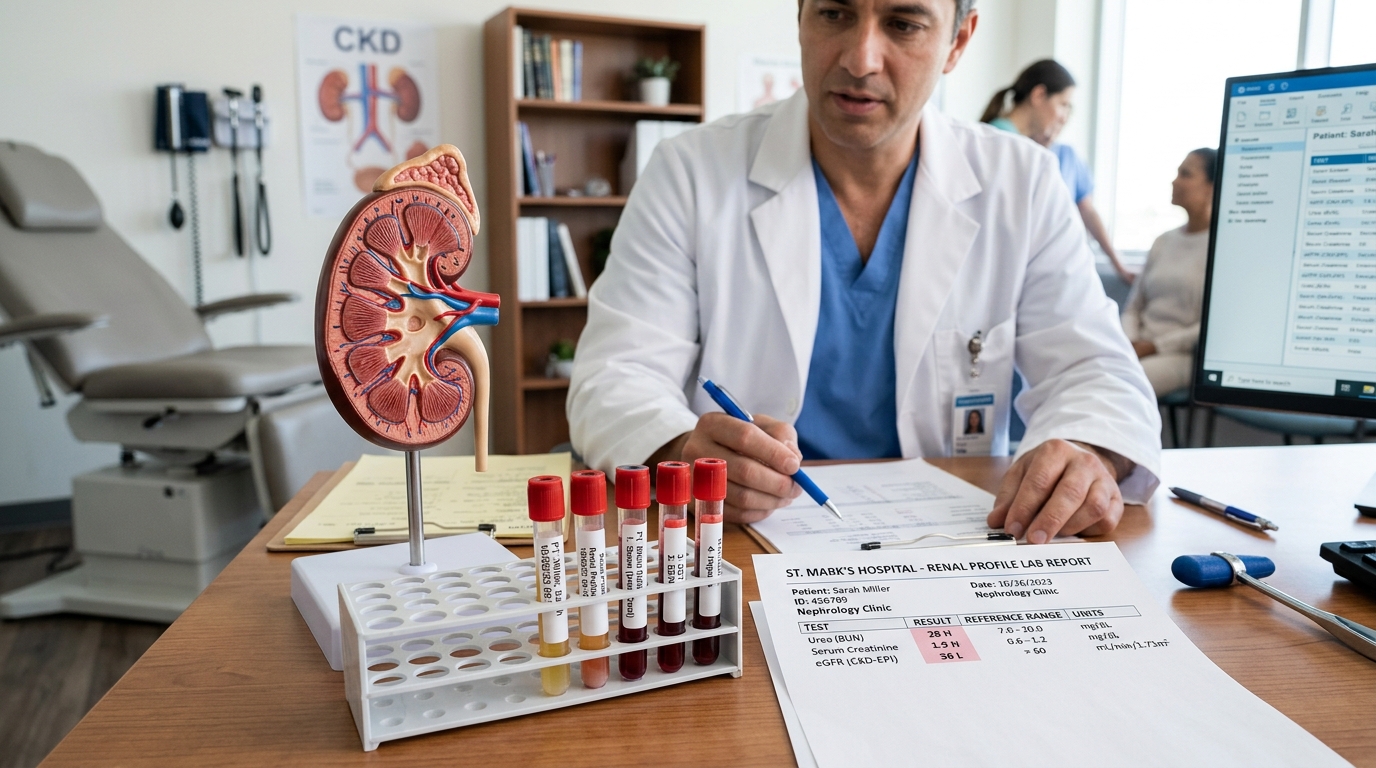
The kidneys are two bean-shaped organs that filter approximately 180 liters of blood every 24 hours, clearing toxic nitrogenous waste products, regulating fluid balance, maintaining electrolyte equilibrium, and secreting critical hormones. Chronic Kidney Disease (CKD) is one of the most insidious medical conditions because nephrons possess immense compensatory reserve: as individual filtering units become damaged by high blood pressure or diabetes, the remaining healthy nephrons hyperfilter to compensate. Consequently, a patient can lose over half their functional kidney capacity without experiencing pain, fluid swelling, or urinary changes. A routine Kidney Function Test (KFT / RFT) detects biochemical filtration strain long before irreversible kidney failure develops.
How the Kidneys Filter Blood
Within each human kidney, approximately one million microscopic vascular filtering units called nephrons work continuously. Blood enters the glomerulus under high pressure, where water, electrolytes, glucose, and metabolic waste pass across the glomerular filtration barrier into Bowman's capsule. The renal tubules then reabsorb 99% of filtered water and vital nutrients back into circulation, while shunting concentrated metabolic waste products (urea, creatinine, uric acid, excess hydrogen ions, and potassium) into urine.
When systemic conditions like hypertension, diabetes, or autoimmune glomerulonephritis injure the delicate glomerular capillaries, the filtration rate declines, causing nitrogenous toxins to accumulate in circulating blood (a state known as azotemia). You can evaluate your renal parameters easily with a Kidney Function Test at home.
Core Biomarkers in a Kidney Function Test
A standard clinical KFT panel measures the following essential parameters:
1. Serum Creatinine (Reference: 0.6 to 1.2 mg/dL)
Creatinine is a normal metabolic byproduct of phosphocreatine breakdown in skeletal muscle tissue. Under steady-state conditions, creatinine is produced at a constant rate and eliminated exclusively through glomerular filtration without being reabsorbed by the tubules. Because of this, an elevation in serum creatinine indicates reduced glomerular clearance.
2. Estimated Glomerular Filtration Rate (eGFR)
Serum creatinine levels can vary based on muscle mass (a muscular athlete naturally produces more creatinine than a frail elderly person). To normalize for this, laboratory software calculates the eGFR (mL/min/1.73m²) using validated equations (such as CKD-EPI or MDRD) factoring in age, gender, and serum creatinine. An eGFR above 90 is optimal; values persistently below 60 indicate chronic kidney disease.
3. Blood Urea & Blood Urea Nitrogen (BUN)
Urea is synthesized in the liver as the final end-product of dietary protein metabolism. It is freely filtered by glomeruli, but unlike creatinine, 40% to 50% is passively reabsorbed in the tubules. Comparing BUN to Creatinine (BUN/Creatinine ratio) helps clinicians distinguish between pre-renal azotemia (dehydration, heart failure, high protein intake) and intrinsic renal injury.
4. Serum Uric Acid (Reference: 3.5 to 7.2 mg/dL)
Uric acid is the end product of purine nucleotide degradation. Elevated uric acid (hyperuricemia) can form needle-like monosodium urate crystals in joints (causing acute gouty arthritis) and form uric acid kidney stones in the renal collecting system.
5. Serum Electrolytes (Sodium, Potassium, Chloride)
The kidneys tightly regulate electrolyte balance. Potassium regulation is particularly critical: impaired renal excretion leads to hyperkalemia (> 5.5 mEq/L), a dangerous condition capable of triggering life-threatening cardiac arrhythmias.
eGFR Reference Ranges & Chronic Kidney Disease (CKD) Stages
The Kidney Disease: Improving Global Outcomes (KDIGO) guidelines classify chronic renal health based on eGFR and persistence of kidney damage over at least 3 months:
| CKD Stage | eGFR Range (mL/min/1.73m²) | Clinical Description | Symptoms & Clinical Management |
|---|---|---|---|
| Stage 1 | ≥ 90 | Normal kidney function with documented kidney damage (e.g., microalbuminuria or structural defect). | Asymptomatic. Optimize blood pressure (< 130/80) and blood sugar control (HbA1c < 7.0%). |
| Stage 2 | 60–89 | Mild reduction in kidney function with persistent proteinuria. | Asymptomatic. Monitor KFT every 6 to 12 months; avoid nephrotoxic drugs. |
| Stage 3a | 45–59 | Mild-to-moderate reduction in kidney filtration. | Early fatigue, mild anemia, mild fluid retention. Review medications with a nephrologist. |
| Stage 3b | 30–44 | Moderate-to-severe filtration decline. | Noticeable pedal edema (ankle swelling), nocturia, hypertension worsening, bone-mineral dysregulation. |
| Stage 4 | 15–29 | Severe reduction in kidney filtration. | Pronounced fatigue, nausea, loss of appetite, pruritus (itching). Prepare for renal replacement therapy. |
| Stage 5 | < 15 | Kidney Failure / End-Stage Renal Disease (ESRD). | Uremic symptoms, severe fluid overload. Requires hemodialysis, peritoneal dialysis, or kidney transplant. |
Serum Uric Acid: Gout & Cardiovascular Risk
Hyperuricemia (> 7.0 mg/dL in men, > 6.0 mg/dL in women) occurs when the kidneys under-excrete uric acid or when purine intake (red meat, seafood, beer, high-fructose corn syrup) is excessive. Beyond triggering agonizing joint pain in the big toe (podagra), chronic hyperuricemia causes endothelial dysfunction, renal arteriolosclerosis, and accelerates progression of diabetic kidney disease.
How to Protect and Preserve Your Renal Function
Kidneys cannot easily regenerate lost nephrons, making proactive preservation vital:
- Maintain Strict Blood Pressure Control: High systemic blood pressure directly transmits sheer stress to delicate glomerular capillaries. Keeping BP under 130/80 mmHg is the single most effective way to prevent nephron sclerosis.
- Stop the Overuse of OTC Painkillers (NSAIDs): Non-Steroidal Anti-Inflammatory Drugs (such as Ibuprofen, Diclofenac, Naproxen, and Mefenamic Acid) inhibit renal prostaglandin synthesis, constricting afferent arterioles and reducing renal blood flow. Chronic frequent use is a leading cause of analgesic nephropathy.
- Stay Adequately Hydrated: Drinking sufficient plain water prevents renal crystal precipitation, lowers urinary saturation of stone-forming salts, and flushes nitrogenous waste smoothly.
- Manage Blood Sugar Rigorously: Hyperglycemia induces glomerular hyperfiltration and non-enzymatic glycation of the glomerular basement membrane, leading to progressive diabetic nephropathy. Learn more in our Annual Blood Tests Guide.
Who Needs Regular KFT Monitoring?
Annual KFT screening is part of a routine Full Body Checkup for all adults over 30. However, semi-annual (every 6 months) KFT testing is essential for:
- Individuals with diagnosed Type 1 or Type 2 Diabetes.
- Individuals taking antihypertensive medications (especially ACE inhibitors or ARBs).
- Patients with a history of recurrent kidney stones or gout.
- Long-term users of medications that require renal clearance. See our Senior Citizen Health Checkup Guide for geriatric renal monitoring.
Evaluate Your Kidney Function with Doorstep Diagnostic Testing
Book a certified Kidney Function Test (Creatinine, Urea, BUN, Uric Acid, eGFR, Electrolytes) with Mission100. Painless home collection across Delhi NCR and same-day verified reports.
Frequently Asked Questions
Common clinical questions answered by Mission100 physicians.
Fasting is not strictly required for a standalone KFT, but staying well-hydrated with plain water is recommended to avoid dehydration-induced false elevations in BUN and creatinine. If ordered with fasting glucose or lipids, maintain a 10 to 12 hour overnight fast.
This article is grounded in peer-reviewed clinical literature and guidelines from leading healthcare authorities:
- [1](2024). "Clinical Practice Guideline for the Evaluation and Management of Chronic Kidney Disease".
- [2](2023). "KDOQI Clinical Practice Guidelines for Chronic Kidney Disease: Evaluation, Classification, and Stratification".
This content is for general informational and educational purposes only and does not substitute for professional medical advice, diagnosis, or treatment. Always seek the advice of a qualified physician or certified healthcare provider with any questions regarding medical conditions or diagnostic tests.